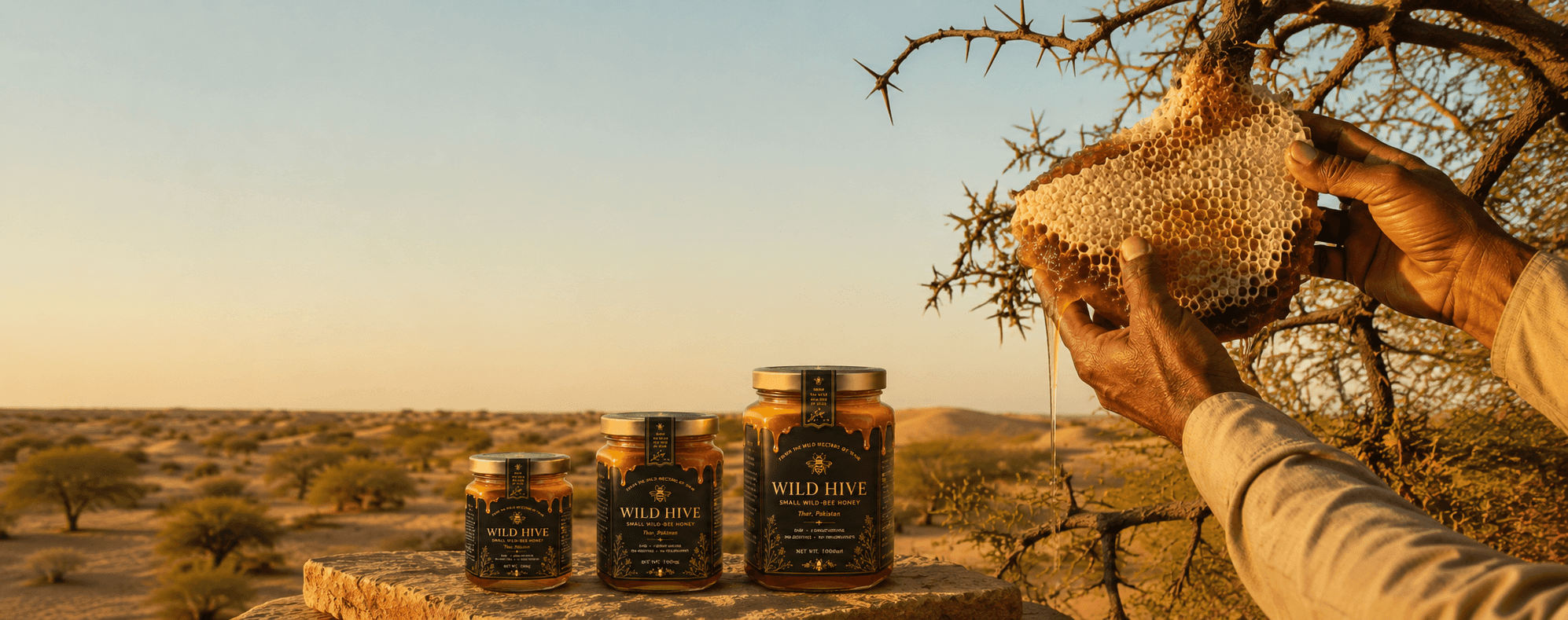
You are cordially invited
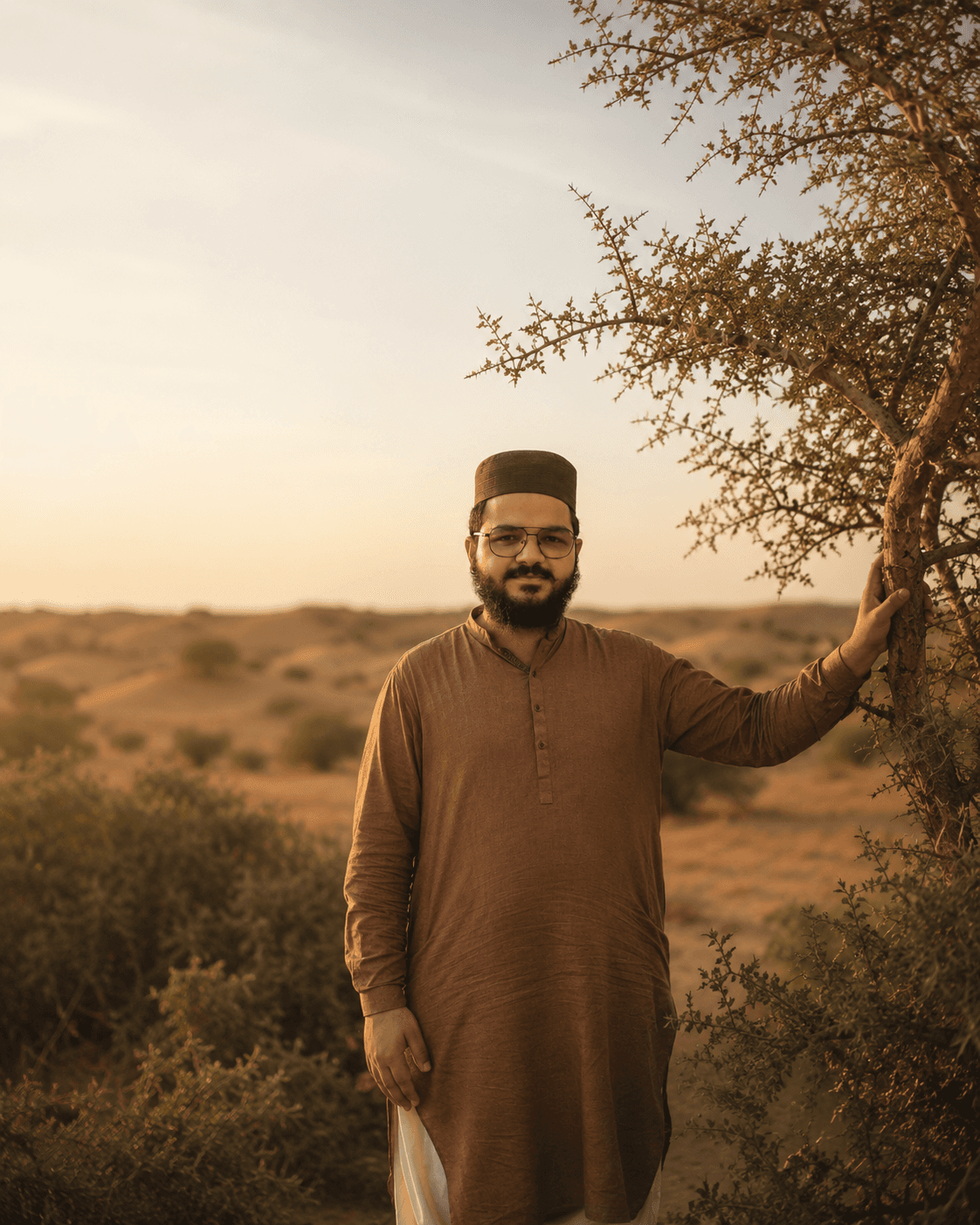
M Mahmood, who set out to bring one desert’s wild honey to families who have only ever been offered a costume of it.
For years my family has quietly eaten real, wild, un-faked honey from one untouched stretch of the Sindh desert, while almost everyone else in Pakistan was handed a costume of it.
This season, for the very first time, we are opening our family’s source to a tiny handful of households outside it.
Dear Honey Lover,
A rare and delicious opportunity is at hand. But there is only a little of it, it disappears the moment this season’s harvest sells out, and it will not return for a whole year, so if what follows speaks to you, read every word now.
Close your eyes for a moment and imagine the finest spoonful of honey you have ever tasted. Now imagine it was better than that. Imagine honey so alive it still carries the scent of the desert it came from. Honey with layers that shift and open on your tongue like a fine perfume, nothing like the flat, one-note sweetness of a plastic bottle. Honey pulled from wild comb this very season, never once heated, never blended, never touched by a factory. The kind you could set in front of the most impossible-to-please elder in your family, and watch their eyebrows lift at the very first taste.
That honey is real. My family has been quietly savoring it for years. And here is the maddening part: almost no one else in Pakistan can get their hands on it. Not because they would not gladly pay for it, but because it barely exists.
Let me explain why, because the moment you understand how rare real wild honey truly is, you will understand exactly what you are being invited to.
Why Real Wild Honey Has Almost Vanished
Most of the honey sold in this country is made in a hurry, to a schedule, in enormous quantity. It is a business built for volume, and volume is the enemy of everything that makes honey extraordinary.
The wild honey I am talking about is the opposite of volume. It comes from wild colonies of the little desert bee, foraging on wild desert bloom that no one planted and no one sprays. Nobody feeds these bees sugar water. Nobody loads their hives onto a truck and drives them to the next crop. They cannot be scaled, farmed, or hurried. You take what the desert gives, once a season, and then you wait a whole year for more.
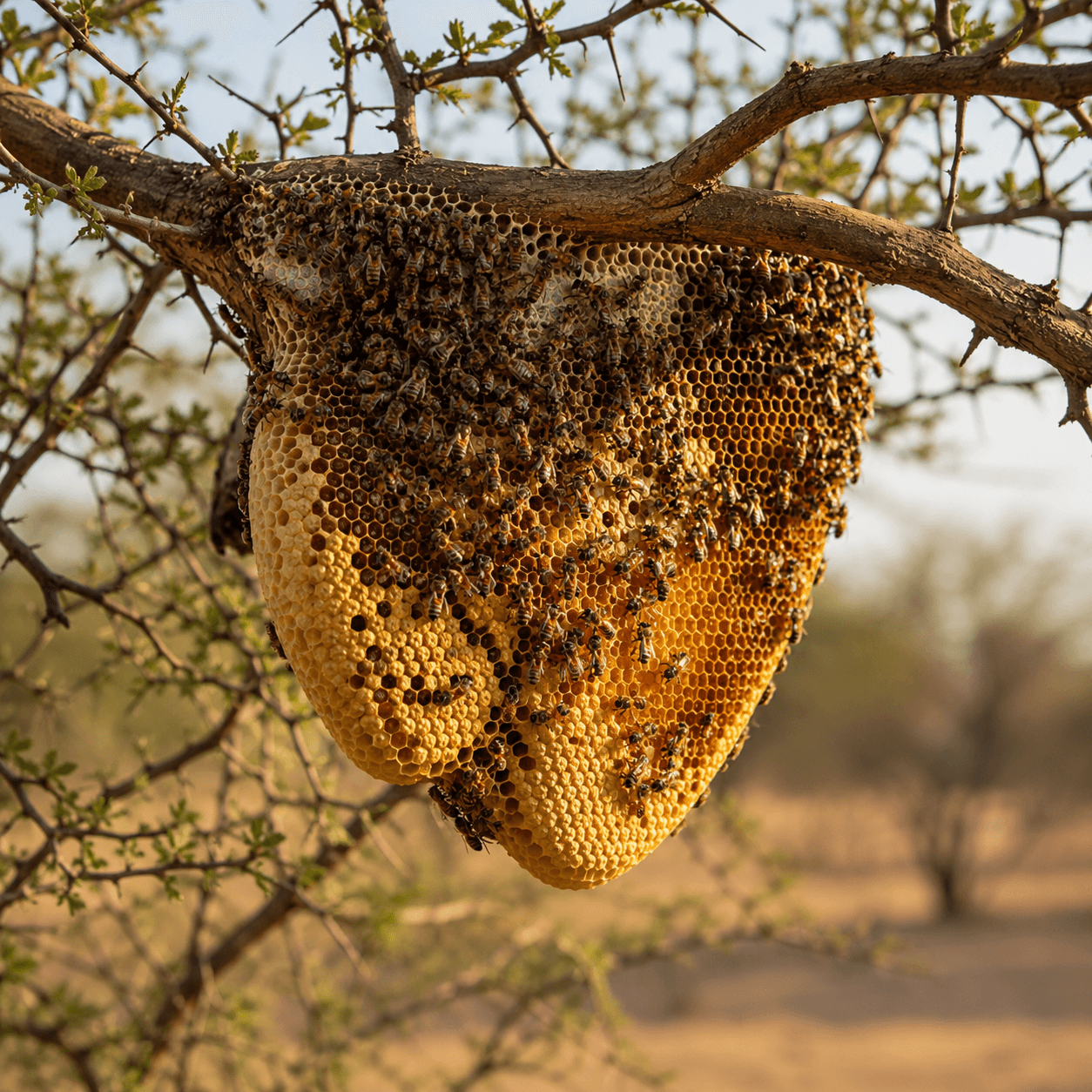
This is the bee. Actual size.
The bee that makes our honey is roughly half the size of the one every commercial hive in the country is built around. It cannot be boxed, fed, trucked between crops, or harvested twice. That single fact is the whole reason this honey is scarce, and the whole reason it costs what it costs.
That is why this whole country produces only a tiny trickle of truly wild honey each year, while the factories pour out hundreds of tonnes. The real thing gets passed hand to hand between the few who happen to know a source. For everyone else, it might as well not exist. My family became one of those rare exceptions, and it happened almost by accident.
Then My Father Went to the Desert
My father is a soldier. Years ago, his posting carried him deep into the Sindh desert, the kind of empty, endless country most Pakistanis will never lay eyes on. And it was out there, far from any shop or city seller, that someone handed him a spoon of wild honey pulled straight from the comb. One taste, and he stopped cold. It was nothing like the golden syrup on city shelves. It was darker. Wilder. It carried a depth and a fragrance he had never once met in a jar. It tasted like a place.
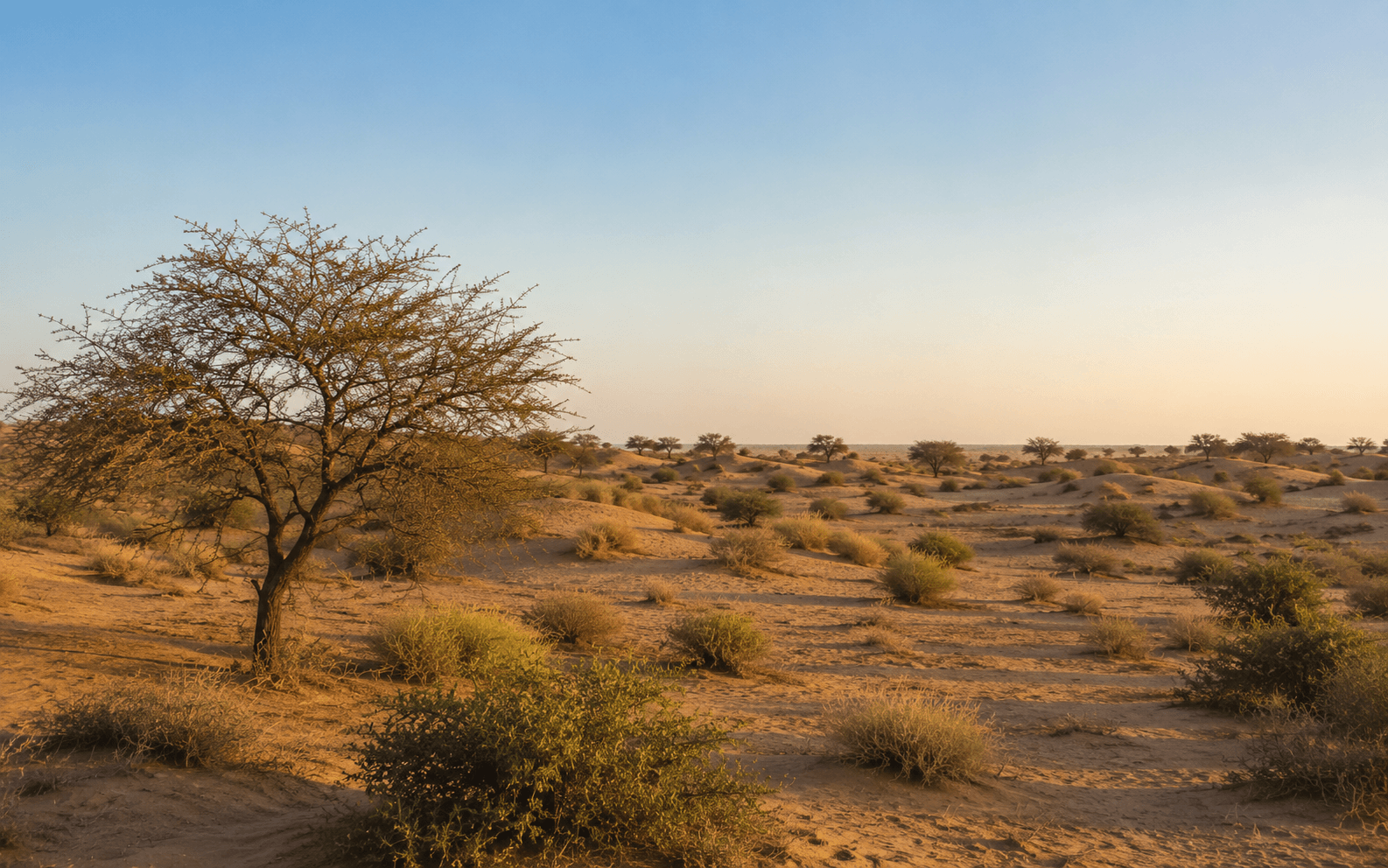
So he began bringing it home. Fifty kilos. A hundred. And giving it away, to my grandfather, to relatives, to anyone in the family who wanted, just once, to taste honey the way it is supposed to be. And every single time, the same thing happened. The jar would empty, and the phone would ring: “Bhai, bhej do aur. Ghar mein sab intezaar kar rahe hain.” Send more. The whole house is waiting.
The honey always ran out. The wanting never did.
For three years this went on, until the answer became obvious. If our own family and friends could not stop asking for it, there was a whole country of families who would feel exactly the same, if only someone would hand it to them honestly. That became Wild Hive.
What Makes This Honey Worth Waiting a Year For
I could fill this page telling you what our honey is not. Instead let me tell you what it is, because that is the part that matters.
It is raw, and it is alive. We never heat it. That one decision changes everything. Heat is what factories use to make honey look flawless and last forever on a shelf, but it quietly kills the living enzymes, the pollen, and the delicate aromatics that made honey worth eating in the first place. Ours keeps all of it, because we leave it exactly as the bee made it.
It is single-origin. Not a blend poured together from ten different farms and drums. One desert. One source. One season. Every jar carries a batch number and the name of the place it came from, printed right on the box. You will always know precisely where your honey was born.
It is fresh from this season’s harvest. Not stock that has sat in a warehouse for two or three years being reprocessed and rebottled. This is Batch WH-2026-01, gathered from wild comb this season and sent to you while it is at its living best.
It carries the taste of the wild. Because these bees forage on a whole desert of wild bloom instead of a single planted crop, the honey is complex. It has range. That is the flavor you cannot fake and cannot farm, and it is the reason people who taste it never go back.
One pin on the map. That is the entire supply.
Most honey in Pakistan reaches you through aggregators: drums arriving from many beekeepers across many regions, combined, and the origin dissolves somewhere in the middle of that chain. Nobody involved can tell you which place your jar came from.
Ours comes from one location. If we ever cannot tell you where a batch came from, we will not sell it.
Batch WH-2026-01 · Printed on every jarFrom wild comb to your kitchen, in three steps
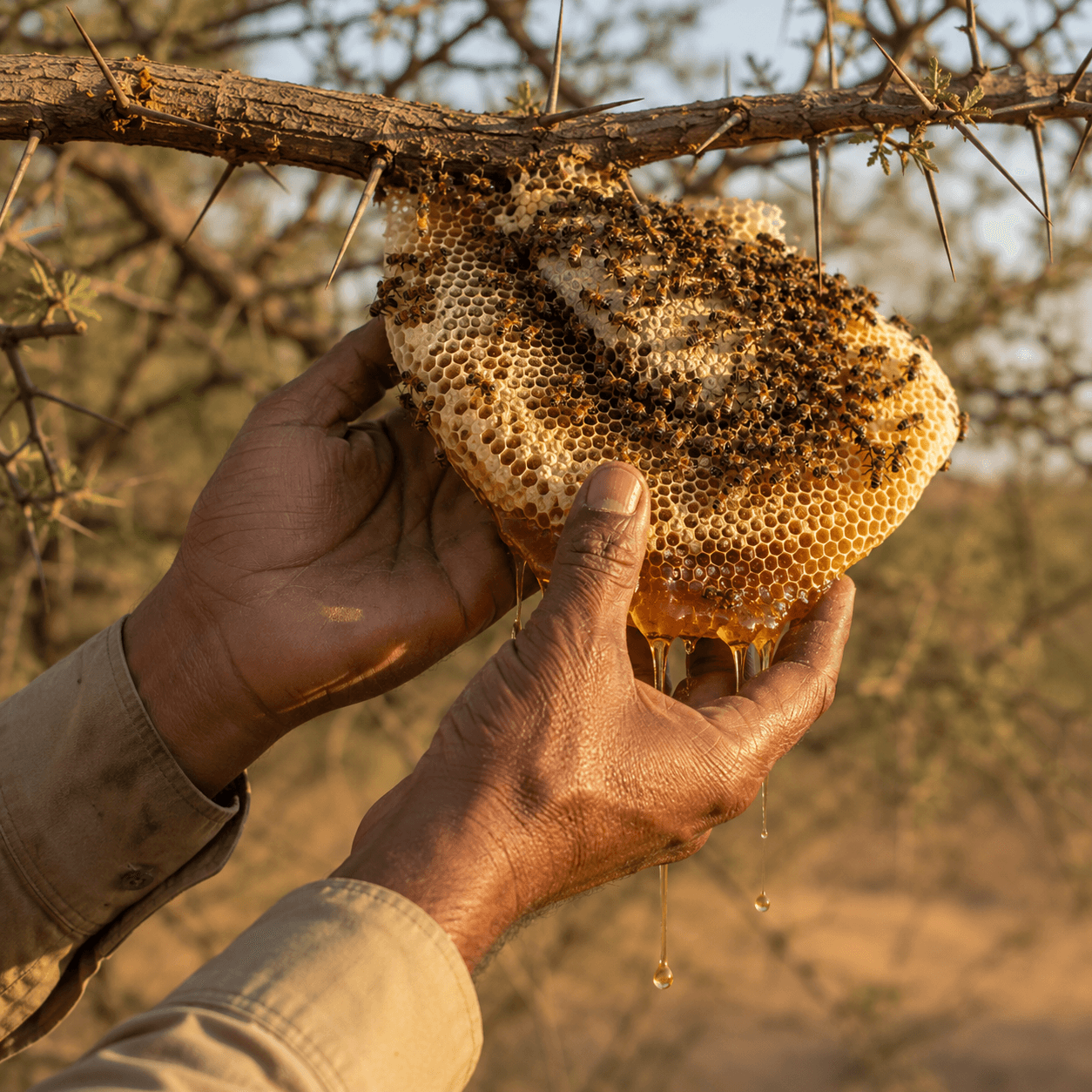
Found, not farmed
Wild comb located on desert branches. Taken once, by hand, at the end of the season.
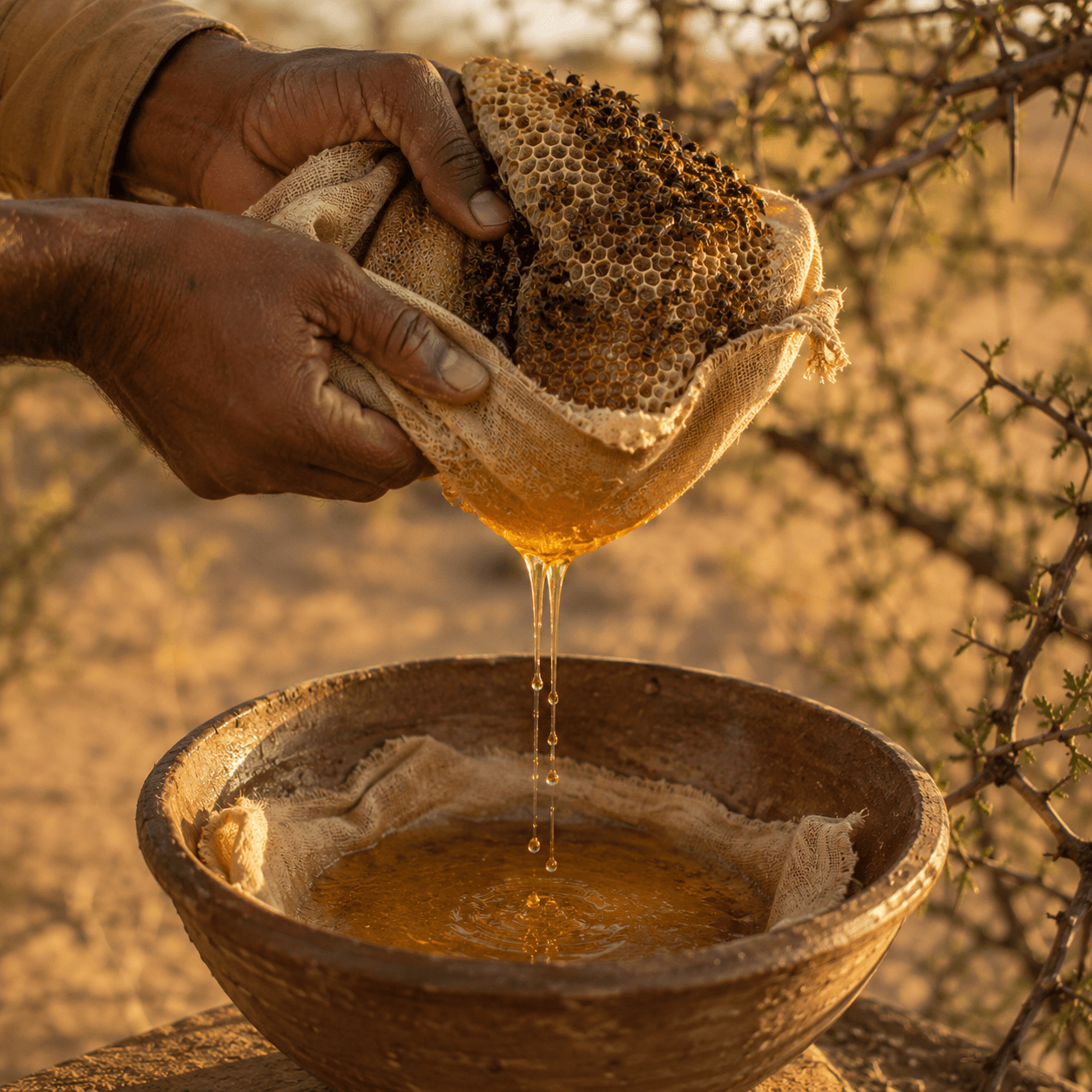
Strained, never heated
Filtered through cloth at room temperature. No pasteurising, no blending, nothing added.
Sealed and numbered
Jarred at our family table. Batch number and source place printed on the box before it ships.
Our source, in the open
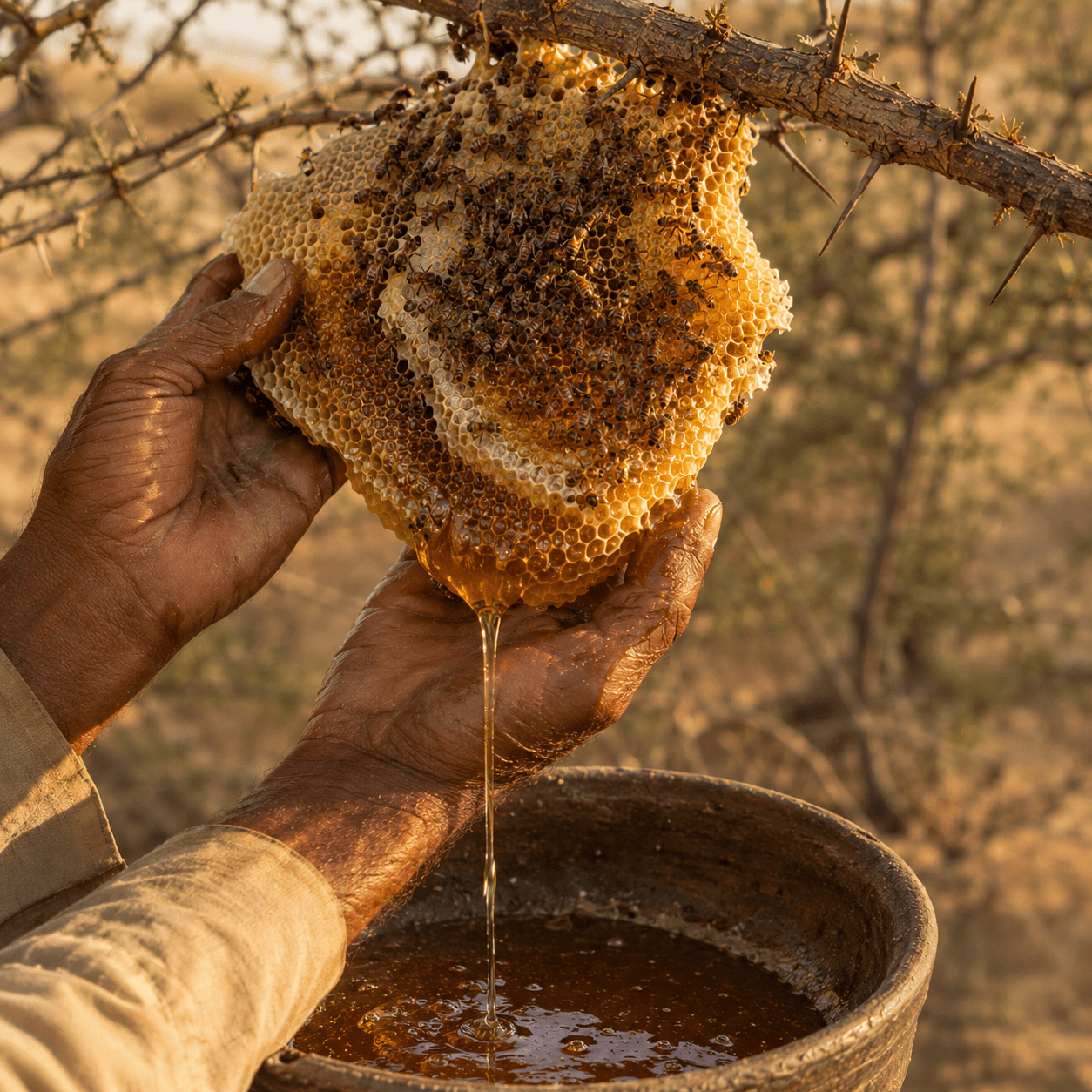
One of us is behind the camera, filming every step. Nothing here is stock photography.
Why There Will Only Ever Be a Handful of These Jars
This is not false scarcity invented to rush you. It is the simple truth of wild harvest. We cannot make more of this honey. There is no dial we can turn to produce another hundred kilos. The desert decides how much there is, once a year, and this season it gave us enough for exactly 757 jars. When they are claimed, we close orders and wait for the next harvest.
That is why this is an invitation and not just a sale. You are being offered a place in a small circle of families who will actually get to keep a jar of this season’s wild honey in their kitchen. Most people will never even know it existed.
757 jars this season. Cash on delivery, anywhere in Pakistan.
Reserve a jarYou Will Be Amazed by the Flavor
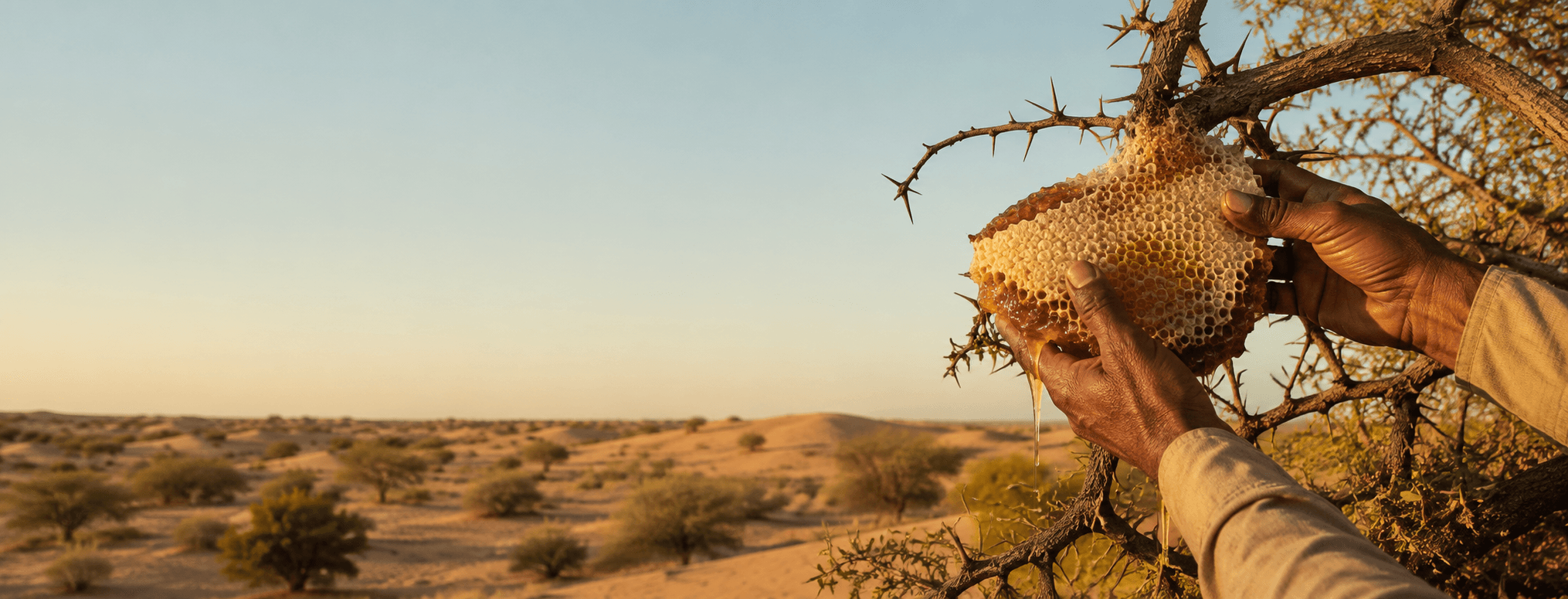
Break the seal, and the first thing that reaches you is not taste. It is smell: deep, floral, wild, the character of a dozen desert blooms folded into one jar. Then you taste it, and it does not simply hit “sweet” and stop. It unfolds. A slow, round, layered sweetness with a faint wildness running underneath it.
Stir it into warm water and lemon at dawn. Spoon it over your child’s toast and watch their face change. Melt it into a winter qehwa and feel it warm you from the inside. Set a jar in front of the elder in your family who has spent seventy years being handed ordinary honey, and watch them taste the real thing.
And here is the feeling I care about most: when you serve this to the people you love, you will know exactly what you are giving them. Not a guess. Not a hope. The real thing. That feeling is the whole reason we built this.
We Are Not a Faceless Brand. We Are a Family.
My father found this honey and spent three years giving it away, asking nothing back. Today his two sons carry it forward, one of us running the business, one of us behind the camera, filming every step so you can see it with your own eyes. Our source. Our harvest. Our packing table. All of it, in the open, because a family telling the truth has nothing to hide.
To us, this honey is not a product. It is an amanah, a trust. My father’s name is on it. Mine is on it. That is worth more to us than any single sale, which is exactly why you can buy from us with your eyes closed.
What you are actually choosing between
An honest comparison. We have not invented a column to make ourselves look better.
honey“Wild” honey,
Rs 2,200/kgWild Hive
| Supermarket honey | “Wild” honey, Rs 2,200/kg | Wild Hive | |
|---|---|---|---|
| Source you can name | ✕ | ✕ | ✓ |
| Batch number on the jar | ✕ | ✕ | ✓ |
| Never heated | ✕ | Sometimes | ✓ |
| Single season, single origin | ✕ | Usually blended | ✓ |
| Available all year round | Yes | Yes | No, one harvest |
| Independent lab report | Sometimes | Sometimes | Not yet |
| Pay after it arrives | ✕ | Sometimes | ✓ |
The People Who Have Already Tasted It Cannot Stop Asking for More
“For three winters my chacha sent us this honey from the desert. Nothing in any shop compares. The moment it finished, we were already asking for the next jar.”
“My father is old and particular. He has refused every 'pure honey' we ever brought him. This is the only one he finishes, and asks for again.”
Taste It With Zero Risk
I want your family at our table for years, not for one order, so the risk is entirely mine. Reserve a jar. Taste it. If it is not the realest, most alive honey you have ever put in your mouth, tell me and we will make it right, no arguments, no forms. And you do not pay a single rupee until the jar is in your hands. Cash on delivery, anywhere in Pakistan.
Reserve a jar from the next harvest
Cash on delivery, anywhere in Pakistan. Rs 300 reserves your jar; the rest is paid when it reaches your hand.
Pre-book your jarThis batch is sold out. The next stock is expected in about a week, and pre-booking holds today’s price — once it lands, the crossed-out prices become the regular ones. Delivery is on us for the 500g and 1kg jars.
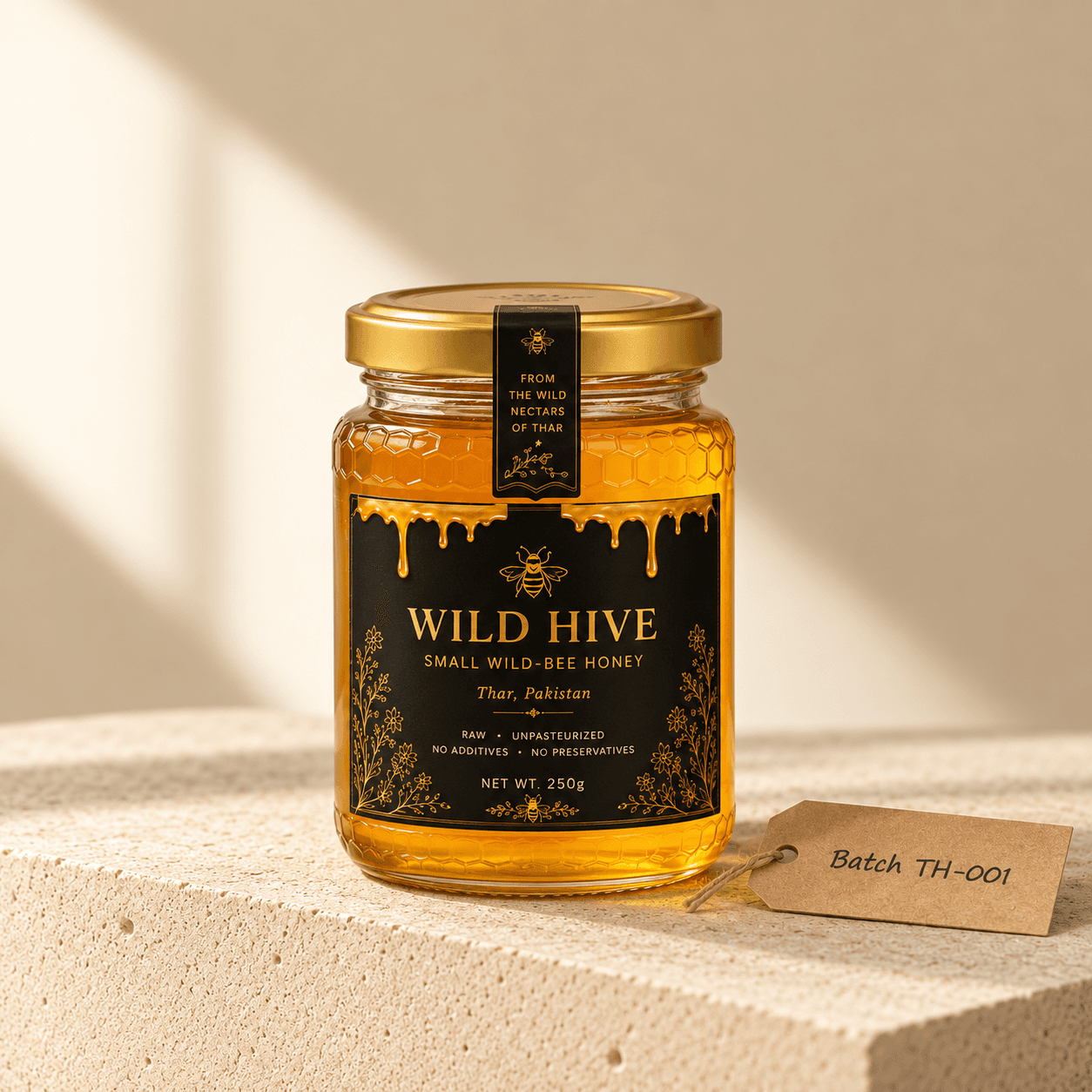
Your first taste, or a gift that will quietly amaze someone.
Pre-order this jar · 250g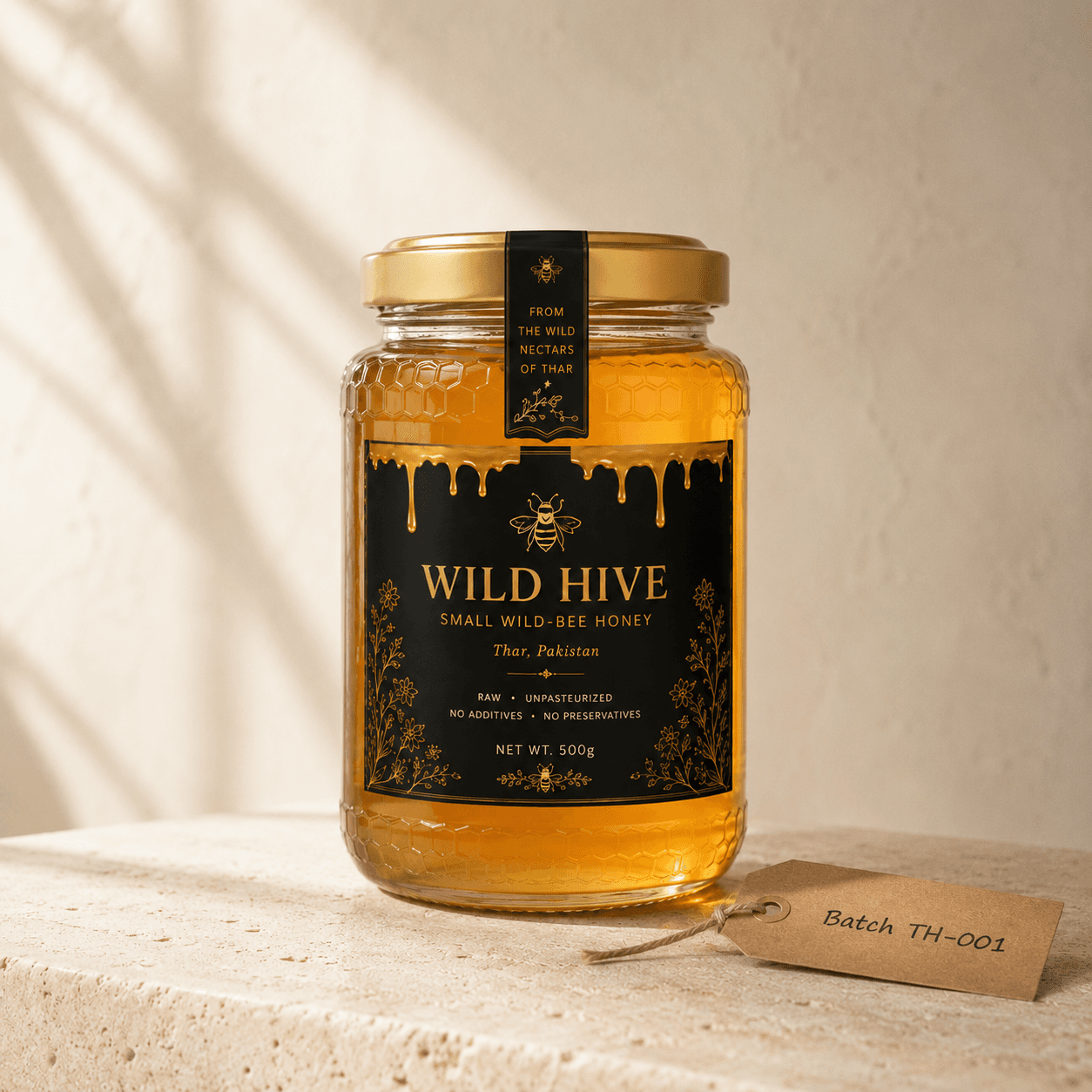
The everyday jar, the one most families come back for once they have tasted the difference.
Pre-order this jar · 500g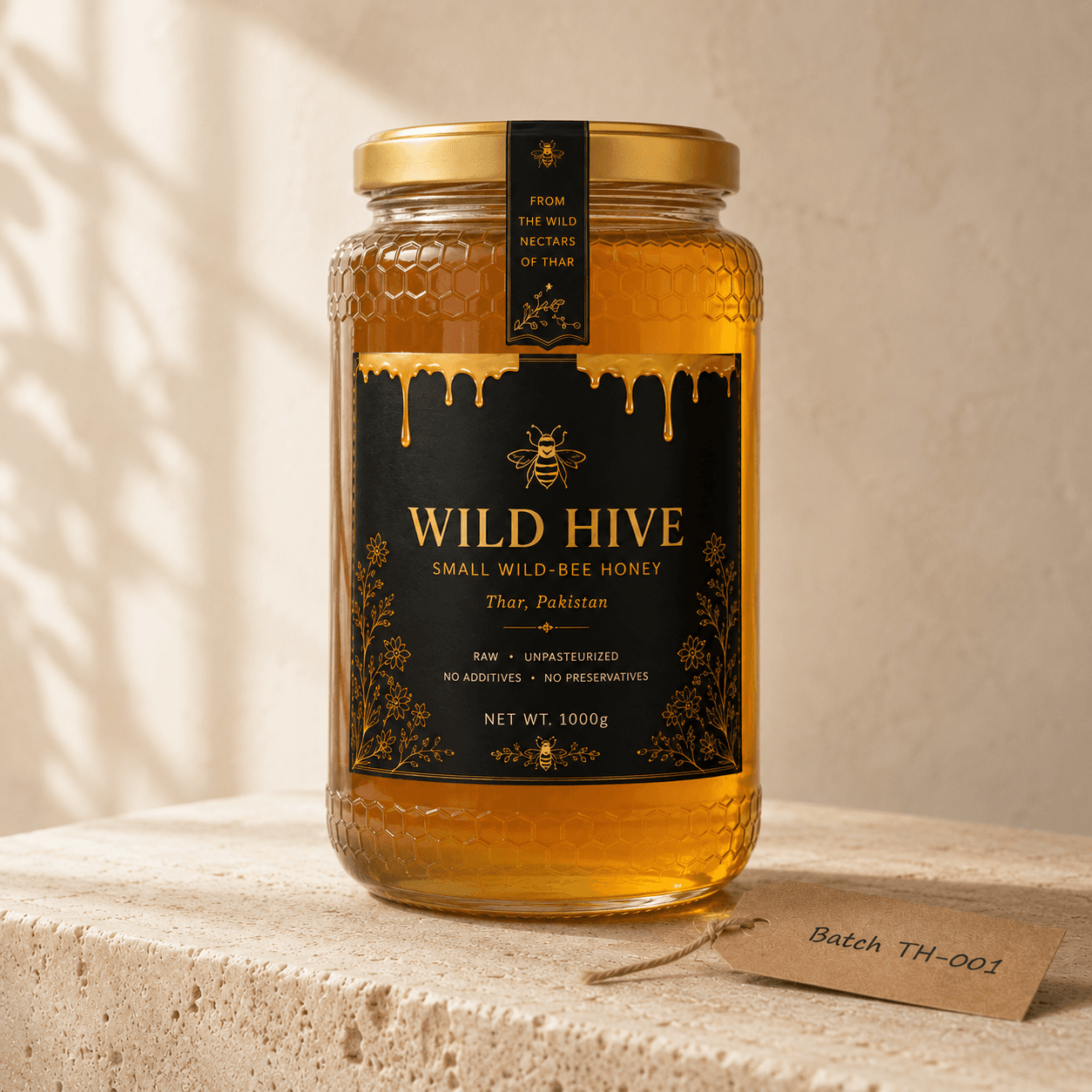
The family jar. Best value, for a house that goes through good honey fast.
Pre-order this jar · 1kgBatch WH-2026-01 · Rs 300 now, the balance in cash when it reaches your hand.
The questions we get asked most
Including the two we would rather you heard from us first.
Your honey stays liquid. Doesn't that mean it's fake?
This is the question we get most, and it deserves a straight answer. You have probably been told that real honey always crystallises, and that a jar staying liquid is proof of adulteration.
That is half right. Crystallising is completely normal for many honeys. But whether honey sets hard or stays smooth depends mostly on its sugar balance: honeys higher in fructose stay liquid far longer. It is chemistry, not fraud.
Ours stays smooth for months. Nothing has been added to keep it that way. That is simply what this honey does.
Do you have a lab report?
Not yet, and we would rather tell you than imply otherwise. This is our first harvest. The lab work is money we have not spent yet.
We could have said nothing; plenty of brands photograph one certificate from one batch and leave it on the website for years. We would rather be straight with you.
What you have today: one named source, one season, a batch number on every jar, our family name on the label, and cash on delivery so you risk nothing. When the report exists, you will see it.
Why does it cost almost double the wild honey I've seen online?
Because at Rs 2,200 a kilo, the seller is buying in volume from an aggregator: mixed sources, mixed seasons, poured into one drum. That is not necessarily fake honey. It is just not traceable, and nobody in that chain can tell you which desert or which month it came from.
We buy one harvest from one place, and our whole batch is {{jarCount}} jars. When it is finished we stop taking orders rather than topping up from a supplier. That costs more per kilo.
What does it taste like?
Darker and more complex than the honey you are used to. Because these bees forage across a whole desert of wild bloom rather than one planted crop, the flavour has range: a slow, layered sweetness with a faint wildness underneath, and a distinct floral aroma the moment you break the seal.
Is it safe for children? Should I take it for a specific health reason?
Raw honey is not recommended for infants under one year, which is standard advice for all honey.
Beyond that, we do not make health claims. Plenty of honey sellers in Pakistan will tell you their product treats specific conditions. We are not going to, because we are not qualified to and because we would rather you trusted the things we do say. If you have a medical question, ask a doctor, not a honey brand.
How long will this batch last?
We genuinely do not know. This season produced {{jarCount}} jars total, and that is the entire supply until the next harvest. When they are claimed, we close orders and the page comes down.
If you are reading this, some are still available.
How does ordering actually work?
Tap “Add to cart” on any jar, fill in your name, number, and address, and place the order. It reaches us instantly, and a person from our family messages you on WhatsApp to confirm before it ships. You pay the courier in cash when it arrives.
Straight from our family to yours,
P.S. This season’s harvest is 757 jars. Not a marketing number, an actual count of what one desert gave us. When they are gone this page comes down until the next harvest, and I would rather you tasted it this year than waited another twelve months.
P.P.S. Remember, you pay nothing until the jar is in your hands. Taste it first. If it is not the realest honey you have ever had, tell me and we will make it right. The only thing you risk is finding out what real honey tastes like.